
Introduction
Breaking Down Access Barriers Across the Peninsula Region
This draft is under development. We welcome your feedback as it takes shape. Check back, as content will change as it develops. Look for a final draft for review in late August.
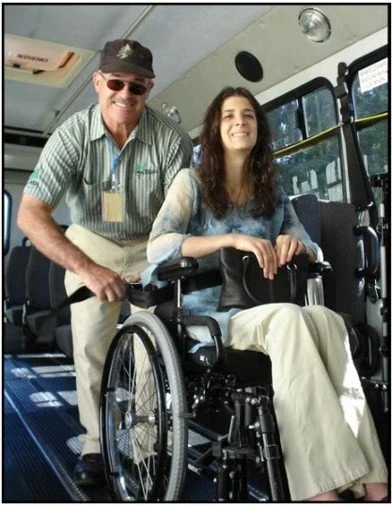
Lift-equipped vehicles such as this Mason Transit operator is using enable mobility of those using wheelchairs or other devices.
Transportation is something many of us don't have to think about too much. When we need to get to work, pick up a sick kid from school, go to the doctor, or shop for groceries, most of us get in our car and drive. Distances are far in rural areas. It takes time, but we factor that into the trip.
But what about those who don't drive?
For lots of people driving is not an option. It might be because age has made driving an increasingly dangerous thing to do. Or maybe a disability, even a temporary condition like a broken leg, makes driving impossible. For an increasing number of people, it is simply too expensive to own a car and keep it running and insured, especially with gas prices soaring.
For those who don't drive, getting around is something they have to think about all the time, especially in a rural place like the Peninsula Region. That's because the places people need to get to - work, school, doctor's office, grocery store, senior center - are generally clustered in the cities. But most people live in unincorporated areas outside of cities, where there are fewer alternatives to driving. It takes more effort to maintain a self-sufficient, independent rural lifestyle without a personal vehicle.
The Human Services Transportation Plan, or HSTP for short, is especially focused on the ability of those who don't drive - whether due to age, income, or disability - to access the health and human services available to them. It is concerned with rural mobility and reliable travel choices that get people where they need to be, even if they don’t drive.
Numerous transportation partners across the Peninsula region provide fixed route bus service, paratransit and on-demand mobility programs, volunteer driver programs, intercity bus service, vanpools and ride-sharing programs, center shuttles, and more. The travel options they offer tend to be concentrated in the region’s cities, where there are densities and concentrations of activities, and on key corridors between cities. Some programs operate outside these urban areas and primary corridors, working to connect the most rural residents with the services they need. It takes coordination, collaboration, and partnerships across sectors to meet mobility needs of the most vulnerable in the region and overcome difficult barriers to rural access.
That's why this periodic update of the Human Services Transportation Plan is so valuable. Every four years PRTPO gets a chance to check in with transportation providers and with those who provide essential health and human services to residents across the Peninsula Region. It’s an opportunity to review mobility needs of their clients, take stock of the services available to meet those needs and the gaps or barriers that remain, and identify strategies that can make things better for people. Importantly, it’s a chance to strengthen coordination and relationships among providers who may not work together on a regular basis, with the aim of improving access and mobility for those who need it most.
HSTP updates open the door for important transportation funding opportunities and help make the case for policy changes that address barriers unique to this highly rural region. PRTPO is updating its Human Services Transportation Plan right now. Read on to learn more and get involved.
Regional Context
Click here for an Excel version of this chart
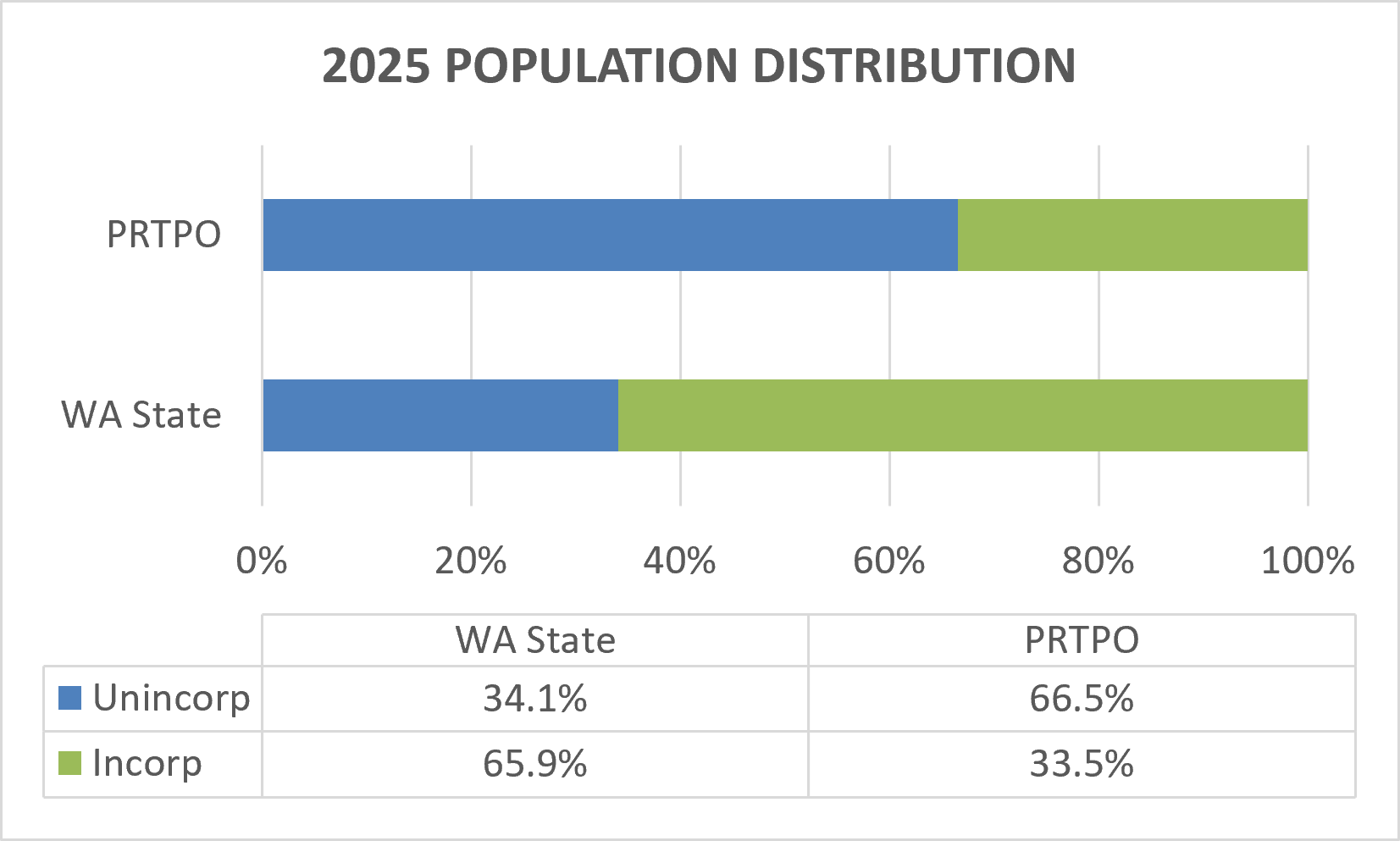
In the Peninsula Region, 1/3 of residents live in its cities and 2/3 live in unincorporated areas, but in Washington as a whole, 2/3 of residents live in cities and only 1/3 lives in unincorporated areas.
Population Characteristics
Transportation Services
The Peninsula Region encompasses four counties on the Olympic and Kitsap Peninsulas: Clallam, Jefferson, Kitsap, and Mason Counties. It’s a highly rural region, with vast national parks and forests, military lands and wildlife preserves, resource lands, and abundant recreational opportunities. Ten tribes call this region home. The stunning beauty and temperate climate, enhanced by the rain shadow of the Olympic Mountains, are a draw for retirees. The region is laced together by a sparse network of state highways, state and local ferries, and rural roads that connect far-flung rural homes to the services and economic opportunities found primarily within its nine cities or in more metropolitan areas like Seattle and Olympia.
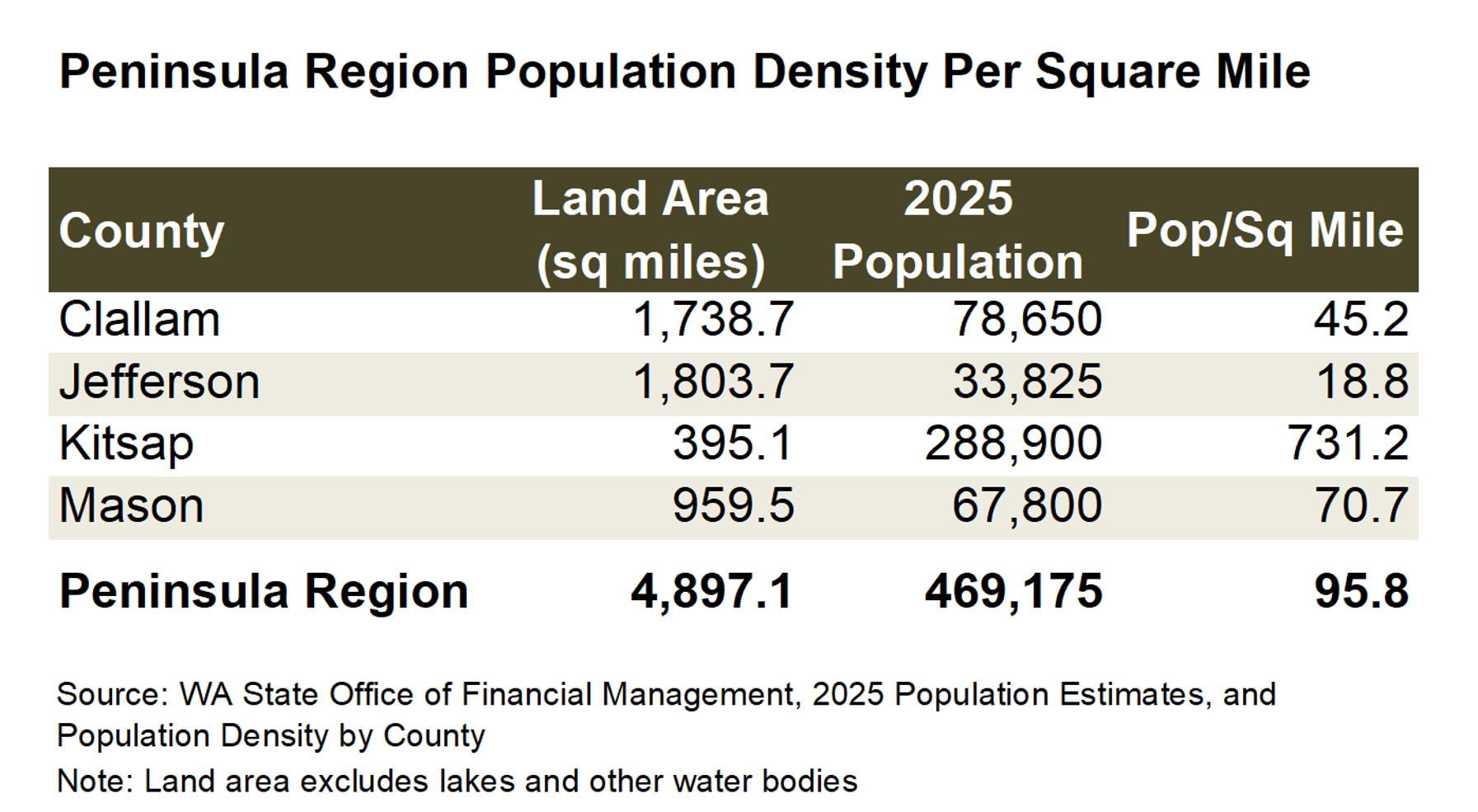
The four counties of the Peninsula Region have a combined 2025 population of 469,175 people; well over half of them live in Kitsap County. This table shows the 2025 population of the four counties that make up the region as well as the population density per square mile. The three most rural counties combined have 180,275 people total. If they were dispersed evenly across the region, which they’re not, that would be just 40 people per square mile. Health and human service providers, like so many jobs, stores, schools, and government services, are in cities because that’s where their services are most accessible to most people.
Those who live in cities have more convenient access to the region’s services and economic opportunities. While many drive, some live close enough to walk or bike to destinations, and have safe options for doing so. Many city residents have good bus service close by. Transit can be a convenient alternative to driving in cities, where there are concentrations of people and activities.
But most people don’t live in these incorporated areas of the Peninsula Region.
Only one-third of the region’s population lives in its cities. Fully two-thirds live in unincorporated parts of the four counties, in rural areas without the array of urban services and transportation choices available to those in incorporated areas. This is the reverse of Washington State as a whole. At the state level, fully two-thirds of people live in incorporated areas and only one-third lives in unincorporated areas.
The highly rural nature of living in the Peninsula Region means that people need to travel much farther to get to work, shopping, schools, health care, and other services than people in less rural parts of the state. Some services that people need aren't even available on the North Olympic Peninsula or in Mason County, requiring further travel to Seattle, Bremerton, or Olympia, where more specialized health care services are located. People often have to navigate the ferry system and contend with Hood Canal Bridge delays. This makes it even more challenging for those who don't drive. Complicating all of this is the looming threat of earthquakes, flooding, or wildfires that can require emergency evacuations to save human life, an activity that is immensely more difficult for those who don’t drive.
This next section sheds a little more light on the people who call the Peninsula Region home.
POPULATION CHARACTERISTICS [pending]
It’s not always easy to maintain mobility and independence in Clallam, Jefferson, Kitsap or Mason Counties without a car, but it's possible thanks to the efforts of transit agencies, tribal transit programs, the Dungeness Line, and numerous independent, innovative programs provided by non-profits and transportation service brokers. This section lists the known transportation service providers, highlights the services they provide, and links to detailed operational information. If you know of transportation providers that are not on this list, please let us know. Non-traditional organizations often provide innovative mobility services and travel support tailored to special population needs that help people get where they’re going or connect to other systems.
Clallam Transit is the public transportation agency serving Clallam County. It operates fixed-route and complementary ADA demand-response services as well as on-demand services in outlying areas. Most routes operate Monday-Saturday. Clallam Transit partners with the Lower Elwha Klallam Tribe and the Jamestown S’Klallam Tribe for services tailored to tribal mobility needs.
13 fixed routes provide service throughout Clallam County. All Clallam Transit fixed-route buses are ADA-accessible for mobility devices.
Interlink is an on-demand microtransit service in Forks and Sequim that provides shared-ride services. Interlink provides point-to-point and timed connections with transit centers, and also can operate with predetermined pickup locations throughout the Forks or Sequim service area. It operates six days a week in both communities. In Sequim service runs from 8:30 - 4:40. In Forks, it operates Mon-Fri from 5:30 am - 5:15 pm, and on Saturday from 7:45 am - 4:45 pm. Reservations can be made and vehicle arrival tracked using the Ride Pingo app and can be made on-demand or up to two hours in advance. On-demand rides can take up to 20 minutes for pickup. Reservations can also be made by calling Clallam Transit. Vehicles are wheelchair accessible.
The Strait Shot offers three daily roundtrips between Port Angeles and the Bainbridge Island Ferry Terminal Mon-Sat, and two roundtrips on Sundays and holidays.
Clallam Connect is a complementary paratransit service providing door-to-door service for those who cannot ride the bus. The reservation-based service is available within 3/4 mile of all fixed-route service during regular hours of operation.
Dial A Ride is a reservation-based, demand response service offered to anyone in rural areas north of Sequim, Mon-Sat. Reservations must be made at least one day in advance. Scheduled service may connect passengers with fixed-route service to reach destinations in the Sequim area.
Clallam Transit
An interactive route map and online trip planner support convenient and efficient route planning. The interactive route map also provides core demographic stats for each route. Passengers can use Locate My Bus, an online tool for real-time tracking of vehicles. Clallam Transit provides timed service connections with Jefferson Transit, Makah Transit, and the Dungeness Line for seamless transfers between systems.
Clallam Transit maintains over 60 bus shelters, five park-and-ride lots, and three transfer centers.
Fares: Clallam Transit service is fare-free for all passengers except for the Strait Shot, the Hurricane Ridge Shuttle, and Clallam Connect service outside of regular service areas. On those routes, reduced or free fares are available for seniors, people with disabilities, youth, veterans, and Peninsula College students. Mobile ticketing is available through Token Ticketing, a phone-based app that enables cashless fare payment.
Jefferson Transit is the public transportation agency serving Jefferson County with fixed-route and complementary ADA demand-response services. Starting in 2026, most service is available seven days a week.
Eight fixed-routes serve east Jefferson County and provide service connections from outlying areas into Port Townsend. All Jefferson Transit fixed-route buses are ADA-accessible for mobility devices.
The Port Townsend shuttle provides regularly scheduled circulator access throughout the city. The corridor connecting uptown and downtown enjoys 20-minute service frequency.
Kingston Express offers three roundtrips daily between the Haines Place park-and-ride and the Kingston Ferry Terminal on Bainbridge Island, where connections can be made to Edmonds via State ferries or to Seattle via State ferries or Kitsap Transit’s Fast Ferry service.
Olympic Connection provides service between Forks and Amanda Park on the west end, with four roundtrips daily, Mon-Fri, and two on Saturdays. Flag stop service is available in addition to scheduled stops, and some route deviation is also available. It offers connections with Grays Harbor Transit in Amanda Park and Clallam Transit in Forks.
Dial-a-Ride is complementary paratransit service providing door-to-door service for those who cannot ride the bus. The reservation-based service is available within 3/4 mile of all fixed-route service during regular hours of operation. Dial-a-Ride operates as a shared origin-to-destination ride service.
Jefferson Transit owns and operates two park-and-ride facilities with a total of 425 free parking spaces between them.
SeaTac Airport is accessible via Jefferson Transit service connections with other public transportation providers.
An online trip planner supports convenient and efficient route planning. Jefferson Transit service connections allow passengers to conveniently extend travel via other transit agencies, including Clallam Transit, Grays Harbor Transit, Island Transit, Kitsap Transit, Mason Transit, and Washington State Ferries.
Fares: Jefferson Transit service is fare-free for all passengers.
Kitsap Transit is the public transportation agency serving Kitsap County with fixed-route transit, passenger-only ferries, shared-ride ADA-compliant paratransit service, on-demand service, mobility programs for people with special needs, and commuter programs..
45 scheduled fixed routes serve Kitsap County. They are organized around North Kitsap, including Bainbridge Island, Central Kitsap, and South Kitsap service areas. Routed buses connect with other services including Kitsap Transit Local Foot Ferries, Kitsap Fast Ferries, and Washington State Ferries, enabling passengers to move easily from one community to another.
Kitsap Transit operates a fleet of passenger-only ferries. Foot ferries provide local access between Annapolis and Bremerton (Monday-Friday) and Port Orchard and Bremerton (Monday-Sunday). High-speed fast ferries provide walk-on service between Bremerton and Seattle, Kingston and Seattle, and Southworth and Seattle. All Fast Ferry routes operate Monday-Saturday and terminate in Seattle at Pier 50, where connections can be made to King County Metro, Sound Transit, and Link Light Rail.
ACCESS buses serve seniors and people with disabilities who are unable to use Kitsap Transit regular routed buses some or all of the time. It is available within a 3/4 mile boundary around each fixed bus route. This shared-ride paratransit service is open to qualified riders and eligible visitors.
On-Demand/Dial-a-Ride services connect residents in outlying areas of Kitsap County, where this is no fixed-route service, to ferry terminals and other important destinations. These on-demand shared-ride services are tailored to the access needs of different part of the county, including Bainbridge Island, Kingston, South Kitsap, and parts of Bremerton. Days and service hours vary by the area served.
Vanlink is a program Kitsap Transit offers to social service providers to help them enhance mobility for their clients. It is designed to enhance mobility for people who qualify as low-income, disabled, veterans or seniors.
The agency serves and operates a network of commuter park and ride facilities throughout Kitsap County, with connections to the four Washington State Ferry terminals, Kitsap Transit Foot Ferry, PSNS, Bangor, Keyport and other employment sites.
An interactive system map enables people to plan their trips, including connections between different modes of travel. Kitsap Transit’s Ride Pingo app makes it easy for people to book rides on any of the on-demand services. The Kitsap Transit Tracker allows people to plan a trip, track their bus, and travel more confidently. Kitsap Transit is part of the central Puget Sound consortium of transit agencies that use the ORCA card for electronic fare payments. A free Travel Training Program provides one-on-one training tailored to the needs of individual travelers so they can learn how Kitsap Transit’s system works and be able to plan their trips and travel with confidence.
Fares: Fares are $2 or less for all services except for westbound trips on the Fast Ferry from Seattle. Those fares are $13 per trip. Discounts are available for Medicare card holders and qualified seniors, disabled and low-income riders paying with a Regional Reduced Fare Permit/ORCA card. Children 18 and younger ride free with an ORCA Youth Transit Pass or student ID.
Mason Transit is the public transportation agency serving Mason County. It operates deviated fixed-route and on-demand Dial-a-Ride service throughout Mason County with connections in neighboring counties.
Ten fixed routes operate Monday-Friday and nine operate on Saturday. There is no Sunday service. These are deviated fixed-routes and may go up to ¾ of a mile off route for a pick-up or drop-off. Routes serve Shelton, Squaxin Reservation at the Kamilche Transit Center, Union, Skokomish Reservation, Hoodsport, Lilliwaup, Grapeview, Allyn, and Belfair. Timed connections between routes enable transfers for longer trips. All Mason Transit buses are ADA-accessible, with ramps and lifts to accommodate wheelchairs, walkers, and other mobility devices.
The McCleary Pilot Route began operating in February 2025, offering service between the Transit-Community Center in downtown Shelton and the McCleary Transit Center. Two roundtrips, Monday-Friday, provide deviated fixed-route service connections with Grays Harbor Transit.
The Zipper Route operates 13 roundtrips Monday-Friday, providing quick and frequent service between the Transit-Community Center in downtown Shelton and the businesses at Wallace Kneeland/Kneeland Plaza on the north side of the city.
Dial-a-Ride offers reservation-based shared-ride service to outlying parts of Mason County that are not served by fixed-route service. Anyone can use Dial-a-Ride. Service is Monday-Saturday, 8:00-5:00. Reservation requests can be made a minimum of two hours in advance and a maximum of two weeks in advance. A minimum 48-hour notice is recommended as reservations are first-come/first-served on a space-available basis. All service begins and ends in Mason County.
Regional fixed-route connections at the Kamilche Transit Center, Olympia Transit Center, McCleary Transit Center, Triton Cove State Park in Brinnon, and the Bremerton Ferry Terminal enable people to connect with Squaxin Island Transit, Intercity Transit, Grays Harbor Transit, Jefferson Transit, Kitsap Transit, Washington State Ferries, Sound Transit, Greyhound, Amtrak, and SeaTac Airport.
Mason Transit operates six park-and-ride facilities throughout the county.
An online trip planner helps people to plan their trips and any connections needed for convenient and efficient travel. Passengers can use the “Where’s My Bus” tracker to see where their buses are in real time. A free Travel Training Program is available to help individuals or groups learn how to use Mason Transit services, plan trips, and travel with confidence.
Fares: Mason Transit service is fare-free for all passengers.
Coming Up
Other transportation providers serving the general public: Dungeness Line, Washington State Ferries
Other transportation providers providing more targeted mobility services: Bainbridge Island Senior/Community Center, Coastal CAP ‘Driven to Opportunities,’ ECHHO ‘Volunteer Drivers Program,’ Jamestown S’Klallam ‘Community Health & Wellness Center’ and ‘Healing Clinic’ Lewis-Mason-Thurston Area Agency on Aging, Lower Elwha Klallam ‘Klallam Transit,’ Makah Transit, Mobility for All, Paratransit Services, Squaxin Island Transit, Suquamish Tribe ‘Elders Program and Services,’ and The Patty Wagon. Who’s missing from this list?
Get in Touch!
To share your thoughts on the 2026 update of the Human Services Transportation Plan that is underway, correct inaccurate information, or help us identify missing information, please drop us a note. Thanks!